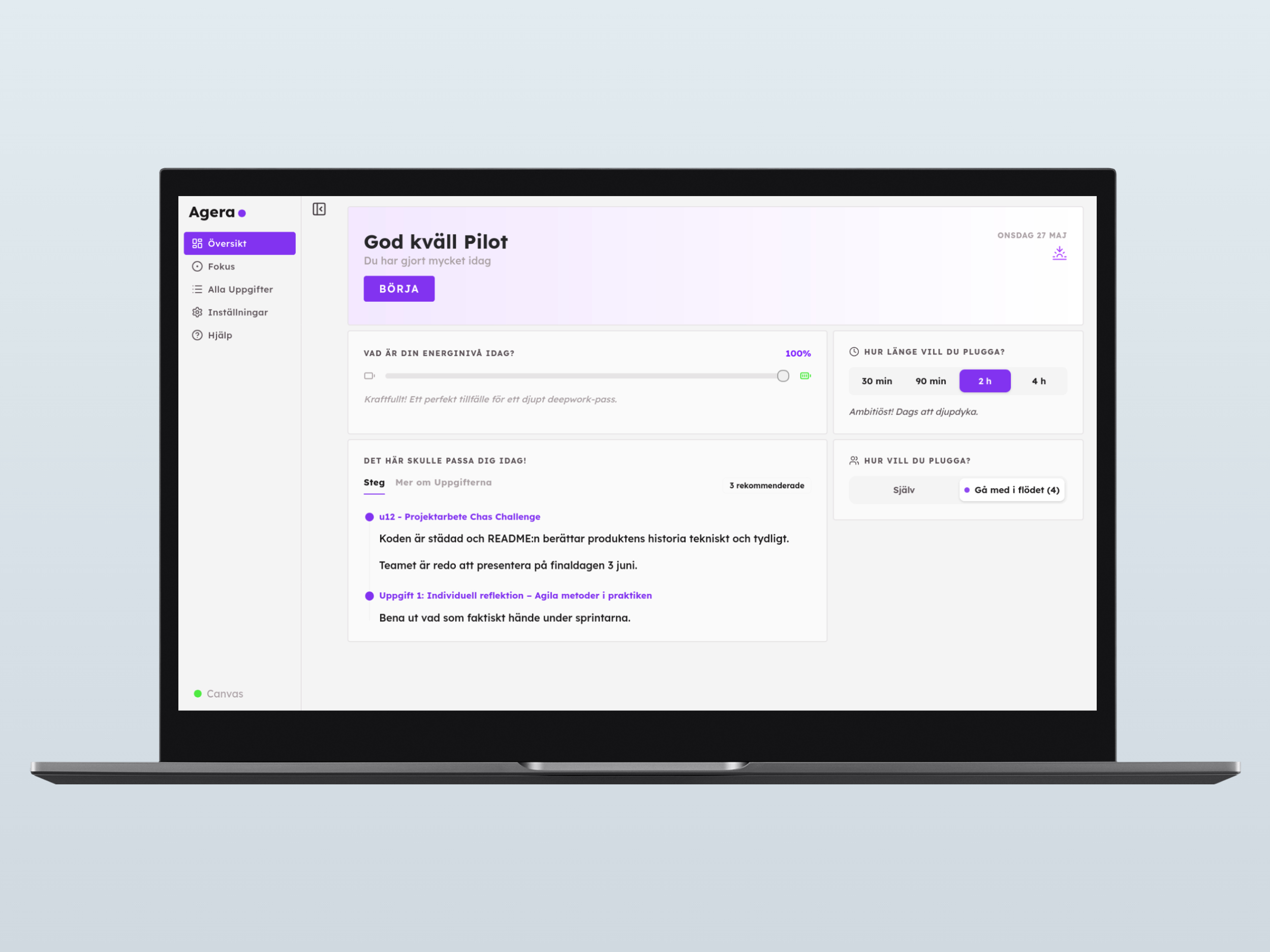
Agera
AI-powered study planner designed to break down complex academic assignments into structured, actionable micro-steps.
Students with neurodevelopmental disorders (NDDs) often struggle with executive dysfunction, making it difficult to plan and initiate academic tasks in an educational system designed for neurotypical minds. As part of Chas Academy's annual "Tech for Good" challenge, I collaborated in a cross-functional team of nine (five fullstack developers, two DevOps, and two UX/UI designers) to build a viable, real-world solution within a tight 2.5-month agile sprint.
To address this challenge, our goal was to build "Agera" (Swedish for "to act"), an assistive platform that ingests complex assignments from learning management systems like Canvas, leverages an LLM to break them down into clear micro-steps, and dynamically prioritizes them based on daily capacity. As a Fullstack Developer, my primary focus was to architect the React frontend and build accessible UI components, while collaboratively contributing to our shared backend packages and the LLM integration pipeline.
To bring this vision to life, I focused heavily on the frontend architecture while contributing flexibly across our shared TypeScript monorepo packages, including database persistence and LLM integration. On the frontend, I established robust state management using TanStack Query—utilizing parallel querying to fetch assignments and micro-steps concurrently—and built accessible, reusable UI components documented in Storybook.
Ultimately, we successfully delivered a fully functional, production-ready MVP within the deadline, which stood out among 18 competing teams to secure a spot as a Top 5 finalist and earn prestigious nominations for both "Choice of the Audience" and "Choice of the Jury." Through this project, I significantly advanced my skills in monorepo architecture, agile team dynamics, and designing highly accessible software for cognitive support.